Middle class student Bob Letellier enters a new world when he meets Alain, a free-thinking rebel who, along with his group of young Parisians, has opted for a life of instant gratification instead of work and commitment. At a party, Bob meets a young woman, Mic, who appears to be just as carefree and cynical as Alain. Mic's only dream is to own a luxury car, and with Bob's help, she manages to find the money to but it. Mic's friend Clo discovers she is pregnant and, not knowing who the father is, she asks Bob to marry her. When they next meet at a party, Bob and Mic deny that they have any feelings for one another - a declaration that soon leads to tragedy... Marcel Carné is widely regarded as one of the standard bearers of French quality cinema of the 1930s and 1940s, responsible for such masterpieces as Quai des brumes (1938) and Les Enfants du Paradis (1945). How ironic then that, in 1958, towards the end of his film-making career, he should make a film which dared to portray the attitudes and behaviour of the 1950s youth, in a way that effectively captures the mood and sentiment of the time. Les Tricheurs was a hugely controversial film, not least because of its blatant depiction of adolescent free-love, and was even banned in some regions of France. It also received some intensely unfavourable reviews, most notably from the young hotheads on the Cahiers du cinéma such as François Truffaut who cited this film as a prime example of the decline of French cinema into mediocrity. In spite of all this negative press, the film proved to be an astonishing commercial success, attracting five million cinema-goers, and was awarded the Grand Prix du Cinéma français in 1958. Whilst Les Tricheurs is not as flawless as Carné's earlier masterpieces, it is nonetheless a significant work, having the power to both shock and move its audience, whilst having great entertainment value. It evokes the mood of its time in a way that few French films of this period did, depicting young people as pleasure-seeking rebels, rejecting the austerity and discipline of the previous generation whilst pursuing a life without cares, responsibilities or love. Similarities with James Dean's films of the 1950s (most notably Rebel without a Cause) are apparent, although Carné's treatment of young people is far more abstract - in his film they merely symbolise a world that has lost its way, more or less victims of post-war prosperity. Although the young people in Les Tricheurs lack the authenticity to be totally credible, the film does make an important, and indeed quite disturbing point, about where the permissive society may be heading. Much of the pleasure of the film is in the performances from its four lead actors, Jacques Charrier, Pascale Petit, Laurent Terzieff and Andréa Parisy, although only Terzieff is really convincing in his role. Marcel Carné originally considered Alain Delon and Jean-Paul Belmondo for the parts of Bob and Alain respectively, before opting for Charrier and Terzieff. As a consolation, Carné offered Belmondo a smaller part in the film - alas too small for the actor to be noticed by the public. Belmondo's breakthrough had to wait until the following year when he starred in Jean-Luc Godard's revolutionary A bout de souffle, a film which offers a very different perspective of the youth generation.
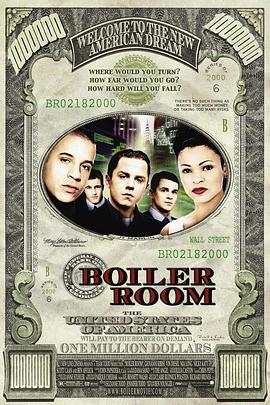
19岁的少年赛斯·戴维斯(吉奥瓦尼·瑞比西 Giovanni Ribisi饰)一心希望能尽快淘到自己的第一桶金,好让父亲另眼相看。他本打算靠玩非法纸牌起家,却发现此路根本行不通,直到一家名为J.T.马林经纪公司的股票经纪商找上了赛维斯。
在这个号称“锅炉房”的核心办公室里,多少个一夜间成为百万富翁的故事深深诱惑着赛维斯。很快,野心勃勃的赛维斯便以优异的成绩通过了股票经济人认证考试,开始了他的“成功之路”。他把那些永远都没有前途的股票卖给利欲熏心的投资者。赛维斯正以极危险的速度追逐着金钱与利益,靠近着他所谓的功成名就,贪婪而不安。在纽约长岛这个瞬息万变的商业圈里,良心未泯的赛维斯终于开始面对良心的考验。
故事发生在一座名叫丹珀西的城市中,布兰达(朱丽安·摩尔 Julianne Moore 饰)年仅四岁的儿子在月黑风高之夜被面目不清的黑衣人绑架,而布兰达自己也惨遭殴打,警探劳伦佐(塞缪尔·杰克逊 Samuel L. Jackson 饰)受理了这一案件。警方将嫌疑人锁定在了黑人身上,这引起了城中众多居民的不满,随着时间的推移,这起看似普通的案件逐渐演变成为了不同种族之间的激烈辩论。
在一名女记者的帮助下,劳伦佐展开了对案件的调查,随着调查的深入,一些可疑的线索逐渐浮出了水面,在这些线索之后隐藏着的,正是个性残暴冷酷的凶手本人。与此同时,城中的热心居民们也开始了寻找被绑架男孩的行动。